If you've ever searched online for information about cybersecurity for your business, you've probably come across the term "SMB cybersecurity." It shows up in articles, software descriptions, and security reports, often without much explanation. For many business owners, that raises a simple question: What does SMB actually mean, and how does it apply to me?
The confusion is understandable. "SMB" is used in cybersecurity in two very different ways, and the overlap can make things unnecessarily complicated. This guide breaks it down in plain English and explains why, regardless of the terminology, most cybersecurity risk for small businesses comes down to one thing: protecting the devices your people use every day.
In most cybersecurity conversations, SMB stands for Small and Medium-Sized Business.
There's no single universal definition, but SMBs are generally organizations that:
This category includes local businesses, nonprofits, churches, professional services firms, and many growing companies. These organizations often share similar challenges: limited budgets, limited time, and limited tolerance for complex security tools.
So when you see "SMB cybersecurity," it usually means security strategies, tools, and services designed specifically for small and medium-sized organizations, rather than large enterprises.
To make things more confusing, SMB is also the name of a technical protocol.
In this context, SMB stands for Server Message Block, which is a file-sharing protocol used by Windows systems and networks. It allows computers to share files, printers, and other resources.
This is a completely different meaning of SMB.
When articles or tools talk about "SMB cybersecurity," they almost always mean small business security, not the file-sharing protocol. But because both terms appear in the same technical space, it's easy to get them mixed up.
At its core, SMB cybersecurity is about reducing risk in environments where resources are limited but the stakes are still high.
Small businesses face many of the same threats as large enterprises:
The difference is not the type of attack. It's the margin for error. A large enterprise might absorb an outage or breach with minimal disruption. A small business may not.
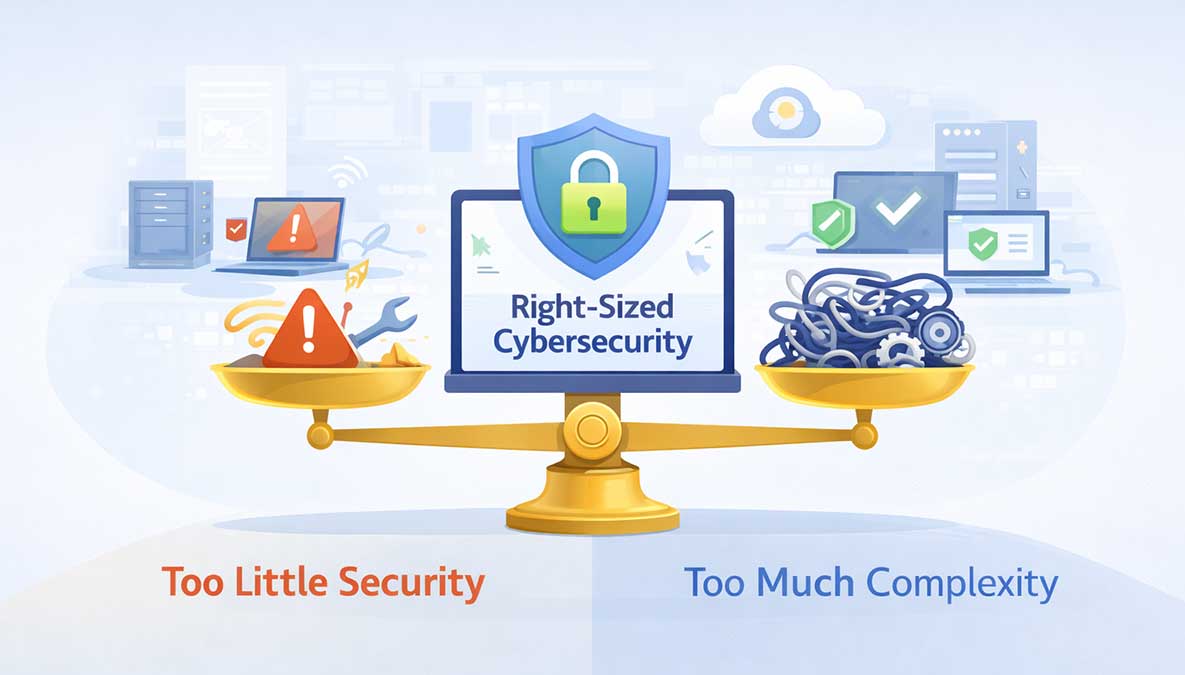
That's why SMB cybersecurity focuses on practical protection, not theoretical perfection.
Sponsored
Most small businesses assume they're too small to be targeted, until something goes wrong. The reality is that modern threats don't discriminate, and staying protected requires constant attention. That's where Simplified Solutions comes in.
Instead of reacting to problems after they happen, you can proactively protect your devices, detect threats early, and stay secure without adding complexity to your day.
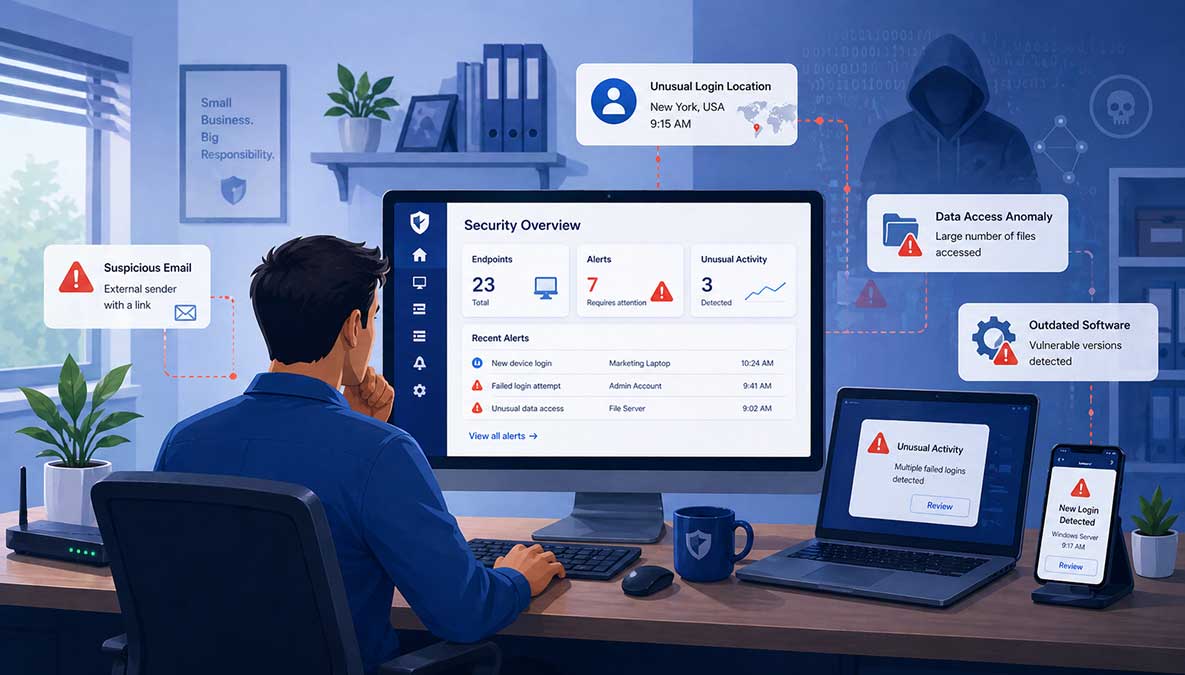
For most small businesses, cybersecurity does not start with firewalls or data centers. It starts with endpoints.
Endpoints are the devices people actually use:
These devices are where email is opened, files are downloaded, passwords are entered, and applications are run. That makes them the most common entry point for attackers.
If an attacker compromises an endpoint, they often don't need to break through anything else. They're already inside.
This is why modern SMB cybersecurity places such heavy emphasis on device-level protection.
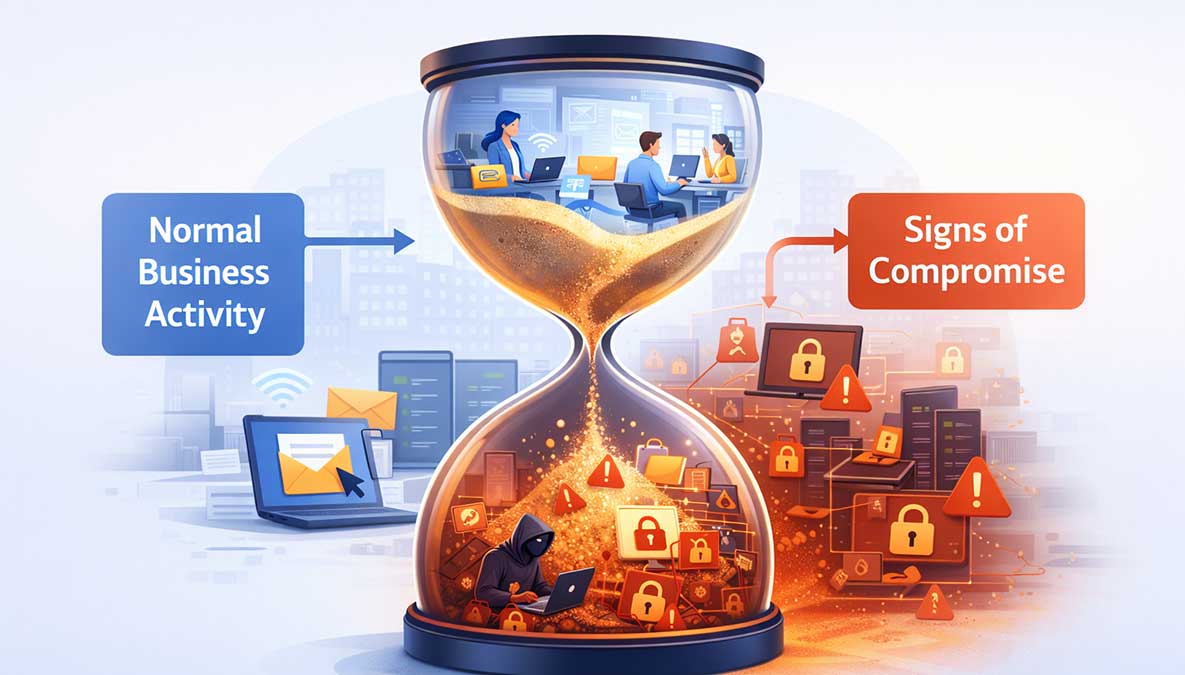
Most attacks against small businesses follow familiar patterns:
None of these steps require advanced hacking techniques. They rely on normal user behavior and unprotected devices.
The goal of SMB cybersecurity is not to eliminate user mistakes entirely. It's to make sure that when something goes wrong, the damage is contained and recoverable.
Because endpoints are the primary risk surface, most SMB-focused security solutions emphasize:
These capabilities work quietly in the background. Users don't need to understand them in order to benefit from them.
This approach reflects a practical reality: small businesses need security that works without constant supervision.
Enterprise security often assumes:
SMB cybersecurity assumes:
That's not a weakness. It's an acknowledgment of how small businesses actually operate. The best SMB security solutions are designed to reduce complexity, not add to it.
Another common misconception is that moving systems to the cloud eliminates the need for device-level protection. In reality, cloud-hosted servers and services still rely on operating systems, credentials, and applications that can be compromised.
Whether a server runs in an office or in the cloud, it is still an endpoint. It still needs to be monitored, patched, and protected.
SMB cybersecurity follows the workload, not the location.
At the end of the day, SMB cybersecurity is not about matching the defenses of a global enterprise. It's about:
When security is done well, it fades into the background. People can focus on running the business instead of worrying about every email or login attempt.
That's the real goal of SMB cybersecurity.
Sponsored
Start your 14-day free trial and get visibility into your devices in minutes, no IT team required.
 Ben Loveless
Co-founder and Developer
Ben Loveless
Co-founder and Developer