Small businesses today have more options than ever when it comes to cybersecurity. You can install tools yourself, configure protections, and manage everything internally. Or you can rely on a managed service provider to handle it for you.
At first glance, the DIY approach can feel appealing. It seems more affordable, more flexible, and more in your control. But as cyber threats become more automated and more persistent, the gap between "having tools" and "being protected" has grown significantly.
If you are evaluating cybersecurity solutions for SMBs, the real question is not whether tools are available. It is whether those tools are being used effectively, consistently, and in real time.
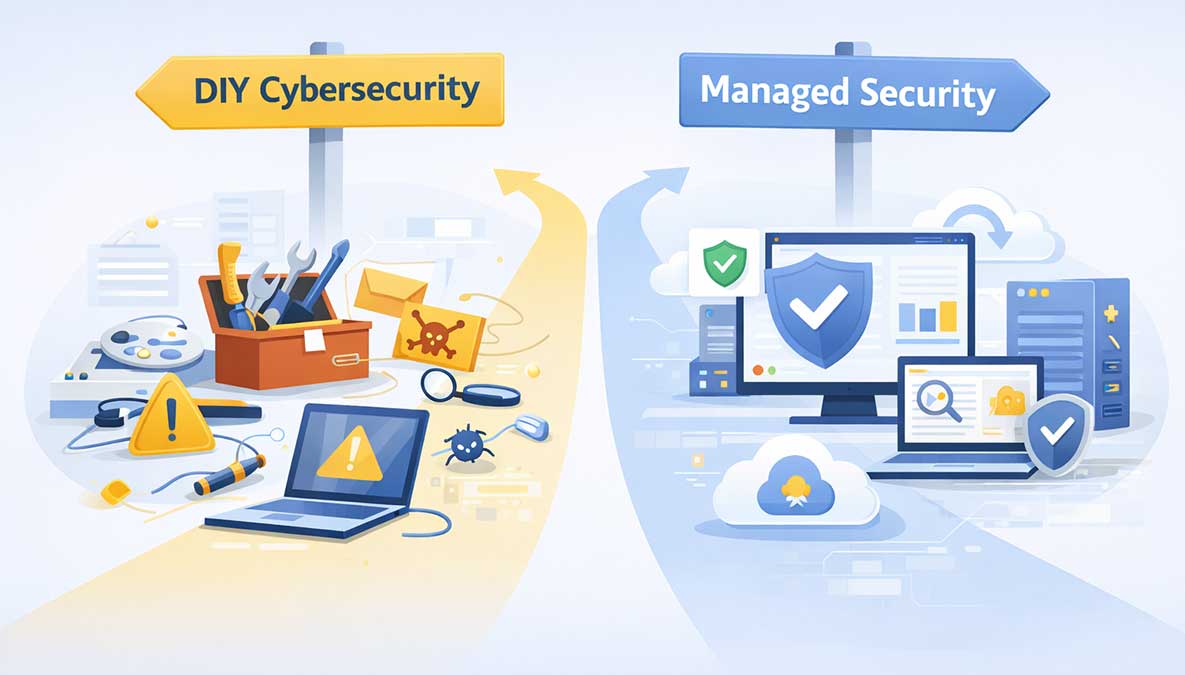
At a high level, the difference between DIY and managed cybersecurity comes down to responsibility.
DIY cybersecurity
With a do-it-yourself approach, your business is responsible for:
This approach can work in very small environments, especially when systems are simple and risks are limited.
Managed cybersecurity services
With managed services, a provider handles most of the operational work, including:
This shifts the burden away from the business and toward a team that focuses on security as a core function.
Most small businesses do not fail because they lack tools. They fail because those tools are not actively managed.
A typical DIY setup might include antivirus, a firewall, and cloud services. On paper, this looks sufficient. In practice, several gaps often appear.
Lack of continuous monitoring
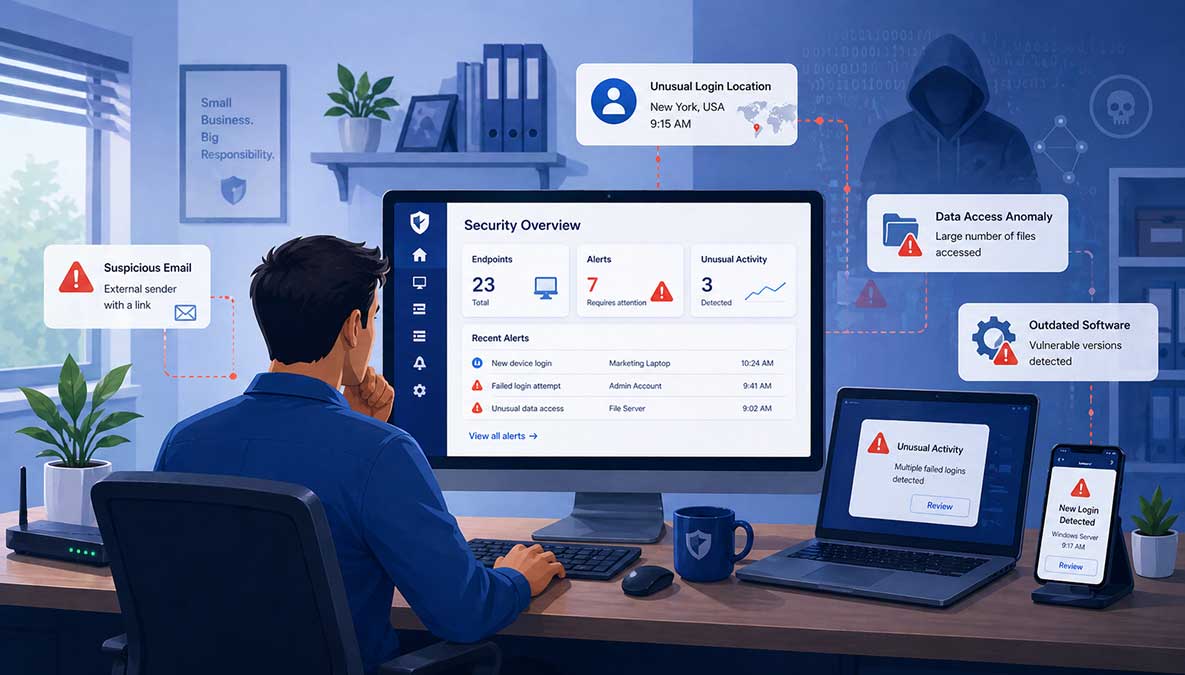
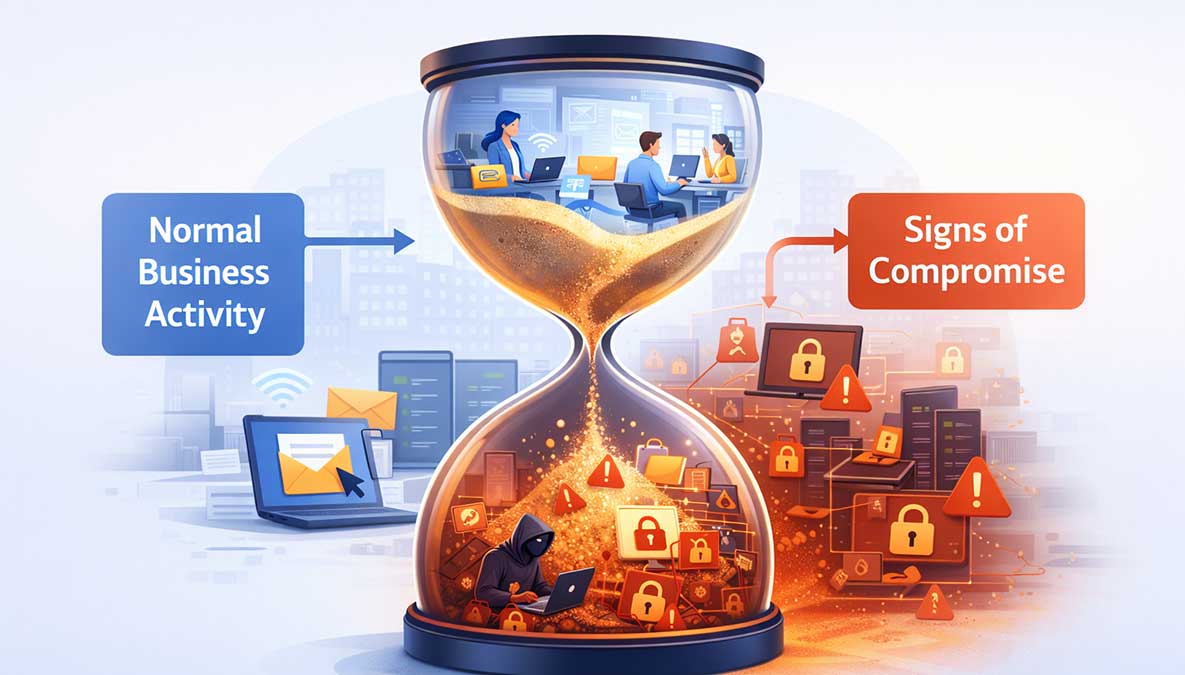
Cyberattacks do not happen on a schedule. They occur at night, on weekends, and during normal business hours.
Without active monitoring, alerts can go unnoticed. A compromised device may remain active for hours or days before anyone realizes there is a problem.
Delayed response to threats
Even when alerts are seen, responding correctly requires experience.
Is the alert a false positive or a real threat?
Should the device be isolated?
Has the attacker already moved laterally?
These are not always simple decisions, and delays increase the impact of an attack.
Inconsistent patching and updates
Keeping systems updated is one of the most effective security measures, but it is also one of the most commonly neglected.
Manual patching often falls behind. Applications remain outdated. Known vulnerabilities stay exposed longer than they should.
Limited visibility across devices
Many DIY environments lack a centralized view of what is happening across all systems.
A laptop may show an alert that no one sees. A server may miss updates without anyone noticing. Over time, these small gaps create larger risks.
Managed cybersecurity services are designed to address these exact problems.
Instead of relying on occasional checks, they provide continuous oversight.
Real-time monitoring and response
Devices are monitored continuously. Suspicious behavior is detected as it happens, and response actions can be taken immediately.
This includes isolating devices, stopping malicious processes, and preventing threats from spreading.
Consistent system management
Updates, patches, and maintenance tasks are handled automatically and consistently.
This reduces the likelihood of known vulnerabilities being exploited by automated scanning tools.
Centralized visibility
All devices, alerts, and system health metrics are visible in one place.
This makes it easier to understand what is happening across the entire environment and to identify issues early.
Combination of automation and human oversight
Modern cybersecurity is not purely automated. The most effective solutions combine automated detection with human review.
Automation provides speed. Humans provide judgment.
This combination is especially important for identifying subtle or unusual activity that may not trigger obvious alerts.
Sponsored
Even when you know what needs to be done, keeping up with updates, monitoring, and security tools can quickly become overwhelming. That's why we created Simplified Solutions.
Instead of spending hours managing devices and worrying about what you might have missed, you can automate protection, streamline maintenance, and focus on running your business.
One of the biggest reasons businesses consider DIY cybersecurity is cost.
At a glance, DIY appears less expensive. You pay for software, but not for ongoing services.
However, the real comparison is not tools versus services. It is risk versus protection.
A DIY setup may save money upfront, but it increases the likelihood of:
As discussed in our article on the real cost of a cyberattack, the cost of a single cyber incident often far exceeds the cost of ongoing protection.
There are situations where a DIY approach can be reasonable.
Even in these cases, the margin for error is small. As the business grows, complexity increases quickly.
For most SMBs, managed services become the more practical option when:
These conditions apply to the majority of small and medium-sized businesses today.
If you have read our guide on small business cybersecurity, you know that SMB cybersecurity is about protecting real-world environments with limited resources.
DIY cybersecurity often assumes time and expertise that small businesses do not have.
Managed services are designed to bridge that gap by providing protection that works without requiring constant attention.
Choosing between DIY and managed cybersecurity is not about control versus convenience. It is about reliability.
Ask yourself:
If the answer to any of these questions is uncertain, the risk increases.
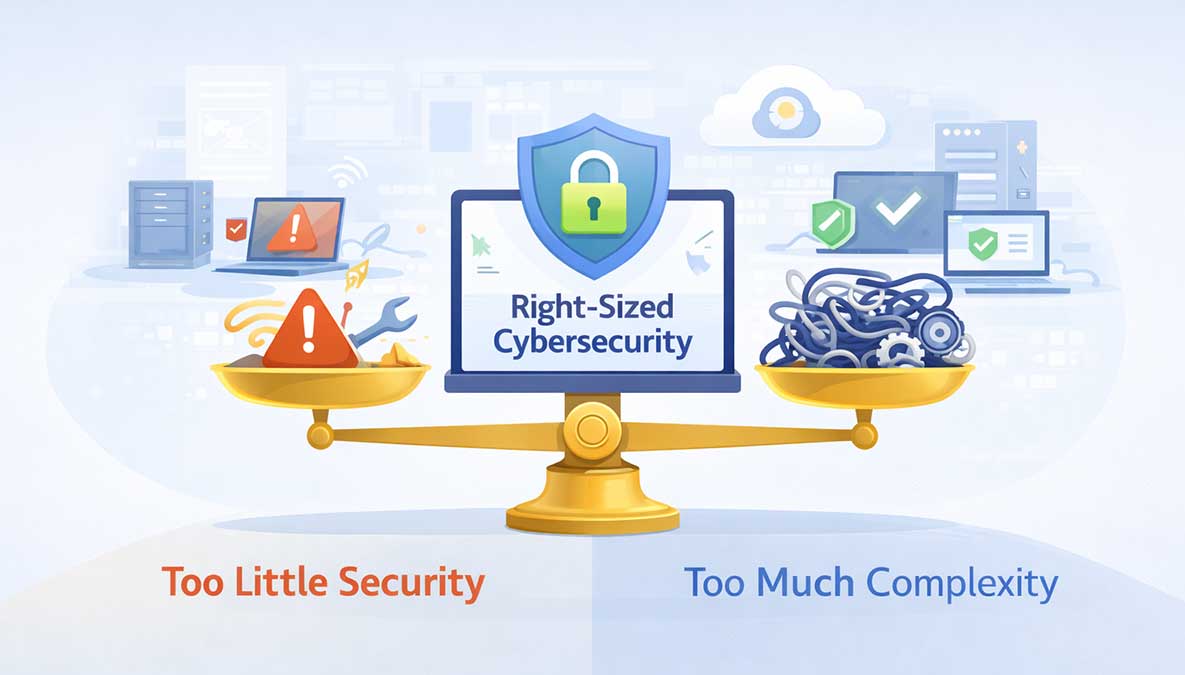
The goal is not to adopt the most complex solution. It is to ensure that your business is consistently protected.
For most SMB environments, the most effective approach includes:
These are the same fundamentals outlined in our cybersecurity checklist.
The difference is whether they are actively managed or left to chance.
Cybersecurity tools are widely available. Effective cybersecurity is not.
As threats become more automated and more persistent, the gap between having protection and actually being protected continues to grow.
For small businesses, the decision between DIY and managed services ultimately comes down to one question:
Is security something you can manage consistently yourself, or is it something that needs to be handled continuously by a dedicated system?
The answer to that question determines your level of risk.
Sponsored
Start your 14-day free trial and get visibility into your devices in minutes, no IT team required.
 Ben Loveless
Co-founder and Developer
Ben Loveless
Co-founder and Developer